WORKSHOPS, Teachings & Creative Research
I approach garment construction as an art form that relies on the interplay with the moving body in order to be complete. Throughout my years as a clothing designer and boutique owner who specializes in custom made garments, I have had the unique opportunity to better understand not only how forms function on the body, but how garments can become a true expression of oneself.
After nearly 15 years owning multiple retail shops and a design collective, I gravitated towards teaching as a means to reconnect with the artistic and experimental side of fashion while engaging with individuals in my community. I have taught workshops and classes at Nike, The Oregon College of Art and Craft and I am currently teaching classes at Pacific Northwest College of Art, Portland State University Fiber Arts Program, and Portland Fashion Institute. My teachings and workshops are inspired by the things that originally inspired me: innovation, experimentation, and sustainable practices. Anchored in these principles, my designs often showcase shape, volume, texture and the interplay these elements have with the moving body. Designed for all skill levels, my teachings and workshops are for individuals who are ready to cultivate their creative vision and apply innovative techniques to push the boundaries of fashion and 3D soft sculpture.
At the forefront of all my creative research and designing is innovation and experimentation. In fashion and garment construction, this means exploring the form and the function of each garment through innovative design techniques and concepts. In a competitive and hyper trending industry, I continually push myself to research and explore new ways to create garments that express artistic and innovative forms that still function with the moving body. These techniques range from exploring innovative patterning techniques with geometric shapes, surface embellishments, fabric manipulations, and zero waste innovation. In all of my creative research, I strive to pursue my creative endeavors with sustainable practices in mind. Sustainability in fashion is broad and complex, but applied systems I have put into my own professional practice are: custom, made-to-order garments for local customers, working with local production teams, sourcing materials locally, upcycling or using more eco friendly textiles, and implementing zero waste patterning and design techniques.

Innovative Design
Portland Fashion Institute
INNOVATIVE DESIGN
Push the boundaries of creativity and create one of a kind garments. In this fashion design lab, students stretch the possibilities of shaping, seaming, handling and manipulating select fabrics to create innovative, wearable silhouettes and details. This class encourages students to think outside the box, expand their own personal design language and use non traditional methods to come up with unique designs. Students develop 3D design ideas by exploring creative 2D patternmaking and 3D draping techniques. This is a special three month class for both non credit and credit at PFI. Students of all skill levels encouraged.
Pre-requisite: Beginning Sewing

Zero Waste Patterning
Fabric Manipulation and Surface Embellishment
PNCA Community Education

Fabric Origami
Oregon College of Art and Craft
Zero Waste Patterning
Explore specific innovative design techniques rooted in alternative patterning and zero waste techniques to create unique garments and 3D forms.
When you challenge yourself to create a pattern that creates zero or very little waste, the surprising outcome is it almost always creates new shapes for the body. When using the concept of tessellating, or fitting together a specific repeated shape in various orientations to reduce waste, you not only reduce waste in your patterning process, but you arrive with some unexpected and innovative shaping for the body.
Through this process, students are asked: how many different ways can this shape be manipulated and repeated to create innovative forms that function on different parts of the moving body? How can these shapes be connected and designed so when cut into fabric, there is zero or very little waste? How can these shapes be molded to various body types to consider a more inclusive sizing? How can these innovative concepts be translated to other 3D forms not specific for a body, but for accessories, soft objects, or sculpture? How do these ideations and designs address a need or creative challenge in a hyper paced, fast-fashion industry?
Pre-requisite: Basic sewing skills
Fabric Manipulation and Surface Embellishment for garments and 3D Forms
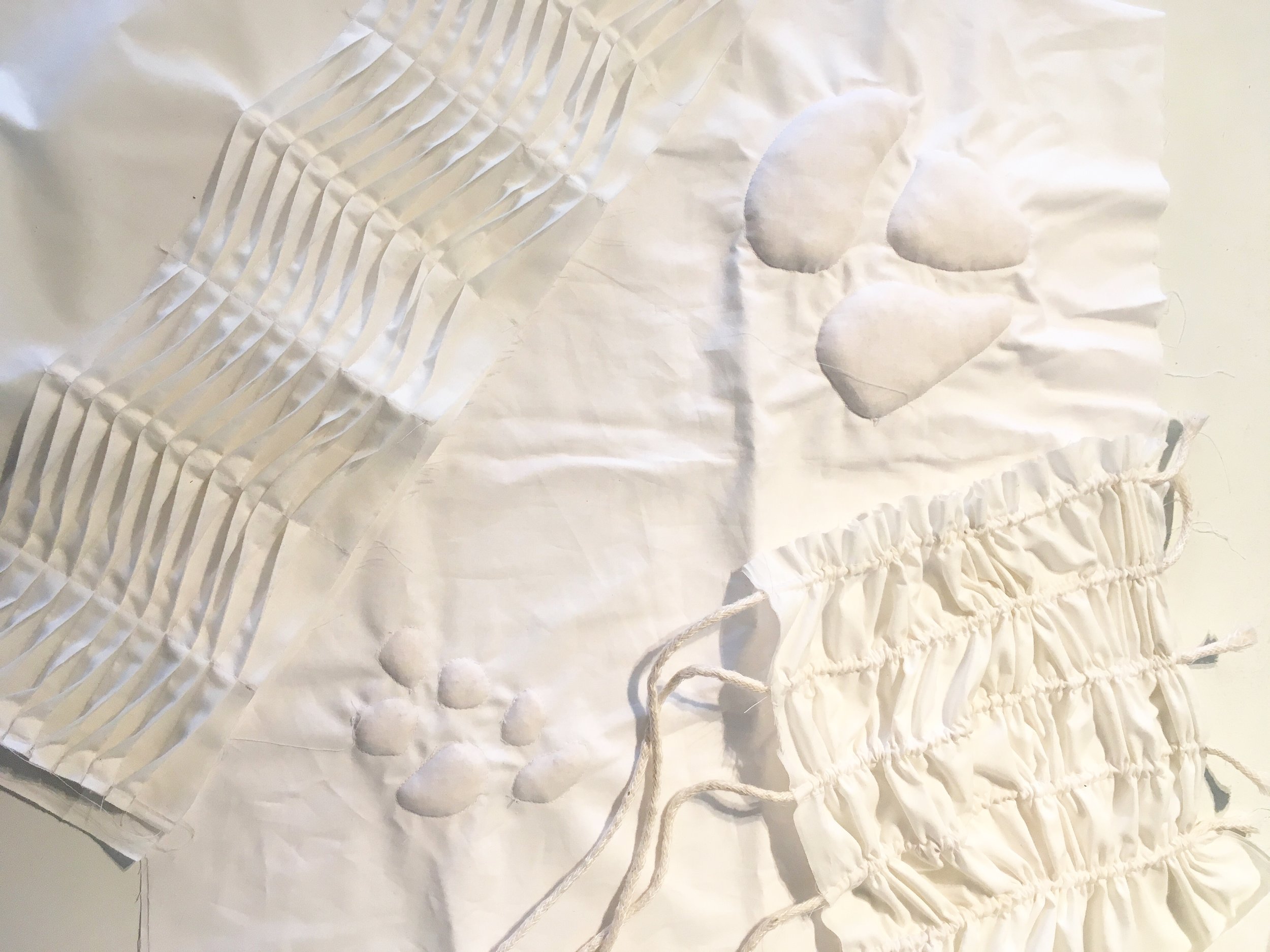
Learn how to embellish and manipulate luscious fabrics to create either a simple garment or functional 3D forms such as pillows, lampshades, or other forms of soft sculpture. In this class, students will explore various fabric manipulation and surface embellishment techniques such as pleating, tucking, shirring, cording, and trapunto with the use of both a sewing machine and hand sewing. Through hands-on instruction and demonstrations, students will learn various fabric manipulation techniques, create muslin samples of each technique, and finally manipulate yardage of a woven fabric of their choosing. This manipulated yardage of fabric will then be used to make either simple wearable tunic, or a functional 3D form of your choosing.
FABRIC ORIGAMI
The simplest garments are those with no cutting and sewing at all and minimalist fashion is becoming increasingly popular. So how can large pieces of fabric form to the body and function as a wearable garment? In many cultures, large geometric shapes are draped, folded and tucked directly on the body to create a garment, such as the traditional Japanese Kimono, the Indian Sari or the traditional Mexican Poncho. Similar to origami, students will drape, tuck and fold large shapes in creative and innovative ways to create unique shapes that will be turned into a garment. Students will be provided instruction on draping and folding techniques to obtain the desired shapes. Students are encouraged to use minimal cutting, creating less fabric waste.
Prerequisites: Beginning/intermediate sewing